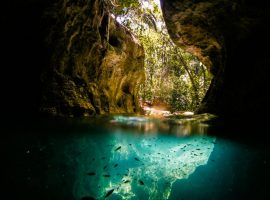
Deep in the Maya Mountains of southern Belize, archaeologists have studied the grave of an ancient Maya woman whose burial may have been fit for royalty.
According to a new preprint, the woman was laid in a shallow pit in Bats’ub Cave in the Toledo District. Her head had been removed, and in its place was part of a vessel holding a single jade bead. A bowl containing five cacao seeds had been placed upside down above her pelvis, surrounded by a large cluster of human teeth.
Rare grave goods
The burial also held a painted bowl showing a figure with its detached head resting on its abdomen, a vessel decorated with a feathered hummingbird serpent and a small rosewood stool. Researchers say the stool is the first of its kind ever found in a burial.
An ancestor remembered for centuries
DNA testing showed the woman was distantly related to several of the people whose teeth were left in the cave. Researchers believe later generations treated her as an ancestor and returned over centuries to honor her.
The genetic data also suggest that elite families traced their descent through the male line, with women marrying into the family.
For the ancient Maya, caves were gateways to the underworld and sacred places to connect with ancestors. Visitors to Belize can see that tradition firsthand at Actun Tunichil Muknal, the ATM cave in Cayo, where ceremonial pottery and human remains still rest where they were left.
Advertisment

Community partnership
The research was carried out under permits from the Belize Institute of Archaeology and the Belize Forest Department, in partnership with the Ya’axché Conservation Trust in the Bladen Nature Reserve. Nearby communities were consulted several times between 2016 and 2024 and have asked that the results be shared in English, Mopan and Q’eqchi’.
The study has not yet been peer reviewed.
Featured Belize Resort
Advertisment

Featured Tour Company
Advertisment

Real Estate Opportunities
Advertisment

Comments
Advertisment

Advertisment
Advertisment

Advertisment