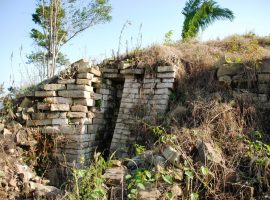
A recent study led by an interdisciplinary team of researchers suggests that unpredictable changes in seasonal rainfall may have played a significant role in the destabilization of ancient Maya societies. The research was conducted by a team that included University of New Mexico archaeologist Keith Prufer and Potsdam Institute for Climate Impact Research’s Tobias Braun.
The team analyzed carbon and oxygen isotopes from a stalactite found in a cave near the ancient Maya city of Uxbenka, allowing them to reconstruct precipitation patterns over the last 1,600 years. The data revealed that rainfall was highly unpredictable between A.D. 700 and 800, which coincides with the decline of many ancient Maya societies.
Advertisment

“Farming in subtropical Central America is tough because freshwater is only available during the summer rainy season,” says Tobias Braun. “Changes of onset and intensity of the rainy season can have serious repercussions for Central American societies.”
This discovery provides new insights into the factors that may have contributed to the disintegration of the political order in some ancient Maya cities. The findings also emphasize the importance of understanding climate change and its potential impact on modern societies, as history has shown that environmental factors can have profound effects on civilizations.
The research has been published in the journal Nature Communications Earth & Environment. For further reading on women rulers in the ancient Maya world, visit “Jungle Realm of the Snake Queens.”
Featured Belize Resort
Advertisment

Featured Tour Company
Advertisment

Real Estate Opportunities
Advertisment

Comments
Advertisment

Advertisment
Advertisment

Advertisment